Introducing AXiRA
Replacing Reverse Osmosis Membranes with Graphene Oxide Membranes
What's Wrong With Reverse Osmosis Membranes?
Here's why RO comes with a heavy price tag
It's Energy-Hungry
55% of total costs in the operation of RO plants is just for electricity.
Because of the inherent high energy requirement for SWRO desalination, seawater is not commonly utilized over traditional surface water. (Kim et al., 2019)
It Has Low Water Permeability
RO membranes have low permeability rates—just 1–2 LMH/bar for seawater and 2–8 LMH/bar for brackish water (Okamoto & Lienhard, 2019).
This means you need even more pressure, more energy, and more money to get clean water.
Our Solution
How we're changing the game with Graphene Oxide technology
Lower Energy, Higher Impact
Up to 50% less energy consumption compared to traditional reverse osmosis systems
Reduces Operational costs by 27% and has anti fouling filters leading to a
Ultra-Thin, Ultra-Effective
GO membranes are incredibly thin, meaning water can flow at high speeds without clogging or damage
Has 14x the water flux/permeability of Reverse Osmosis Membranes
Explore AXiRA
Discover how our Graphene Oxide technology is revolutionizing water filtration systems
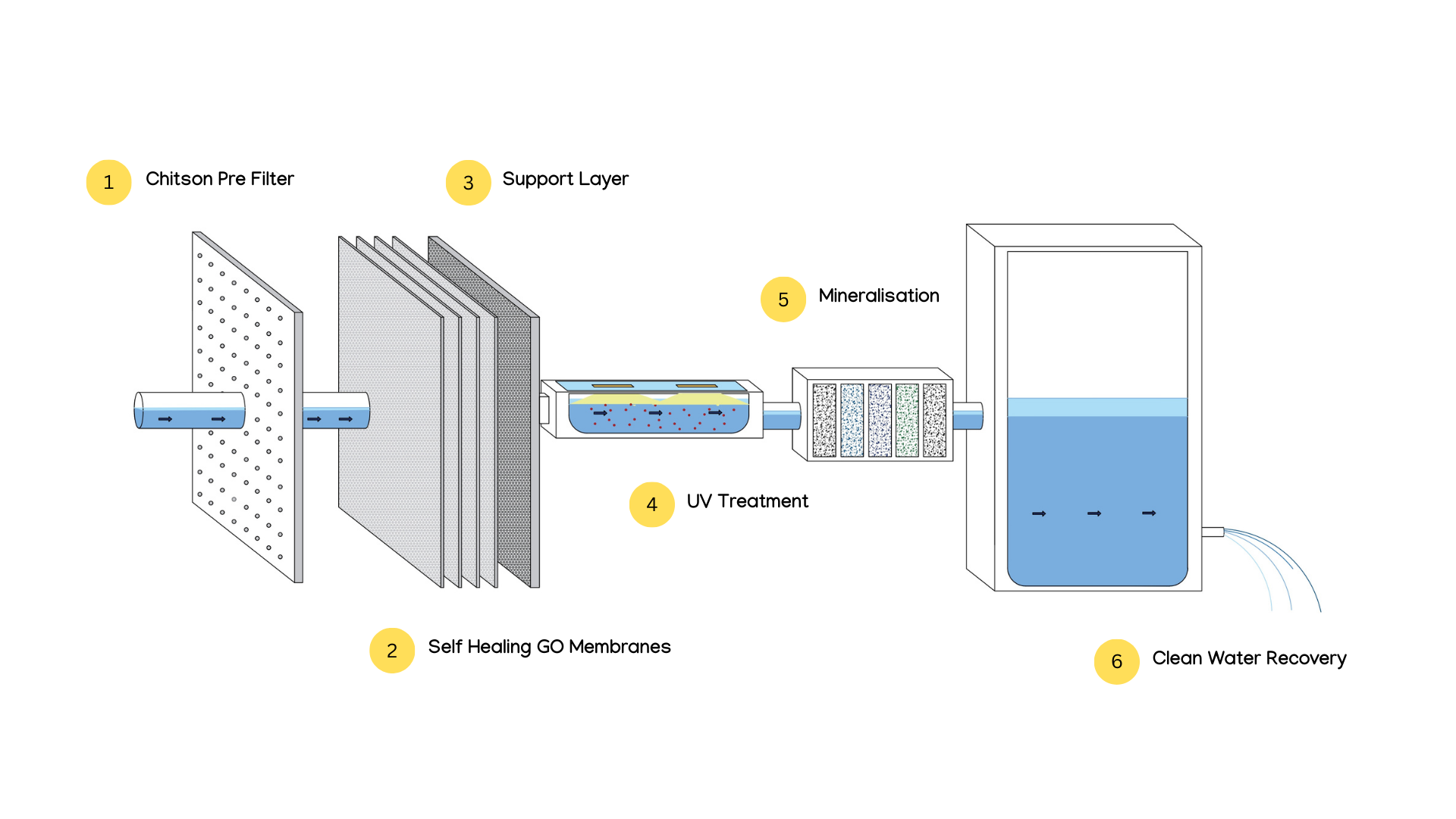
Pre-treatment
Biodegradable nanofiber mesh traps particles, repels biofoulants, and reduces clogging using eco-friendly chitosan-genipin chemistry.
GO Membrane Filtration
Graphene oxide layers filter salts and pollutants, self-heal using reversible bonds, and rest on conductive MXene supports.
Post-filtration
Final treatment includes UV sterilization to eliminate microbes and remineralization to restore taste and essential minerals.
What Experts Say
Hear from industry leaders who have validated our Graphene Oxide technology
Dr. Guihua Yu
Affiliated with University of Texas at Austin
"(Graphene Oxide Filtration Membranes) is a very innovative approach that effectively mitigates key challenges in the field of desalination. The design is particularly beneficial for regions struggling with high-salinity water. Its modular design makes it highly suitable for household water production, allowing for scalability and adaptability to meet individual needs"
Professor David L. Sedlak
SUniversity of California, Berkeley
"Membranes made from graphene or graphene oxide can more effectively remove wastewater contaminants — including pharmaceuticals, pathogens, and endocrine disruptors — than current methods and can be applied to wastewater reuse, water desalinization, and storm water treatment"
Roni Peleg
Editor In Chief at Graphene Info
"The use of graphene oxide filters gave a higher efficiency in eliminating arsenic and fluoride from water as compared to filters without graphene oxide."
Latest Insights
Explore our latest articles, research, and media about Graphene Oxide technology

Meet Our Team
The team behind AXiRA's Graphene Oxide technology